Etsy vs Shopify in 2026: Which Is Right for Your Shop?
Etsy vs Shopify in 2026: an honest comparison of traffic, fees, control and effort for handmade, digital and POD sellers — plus the hybrid strategy top sellers use.
The core trade-off: traffic vs control
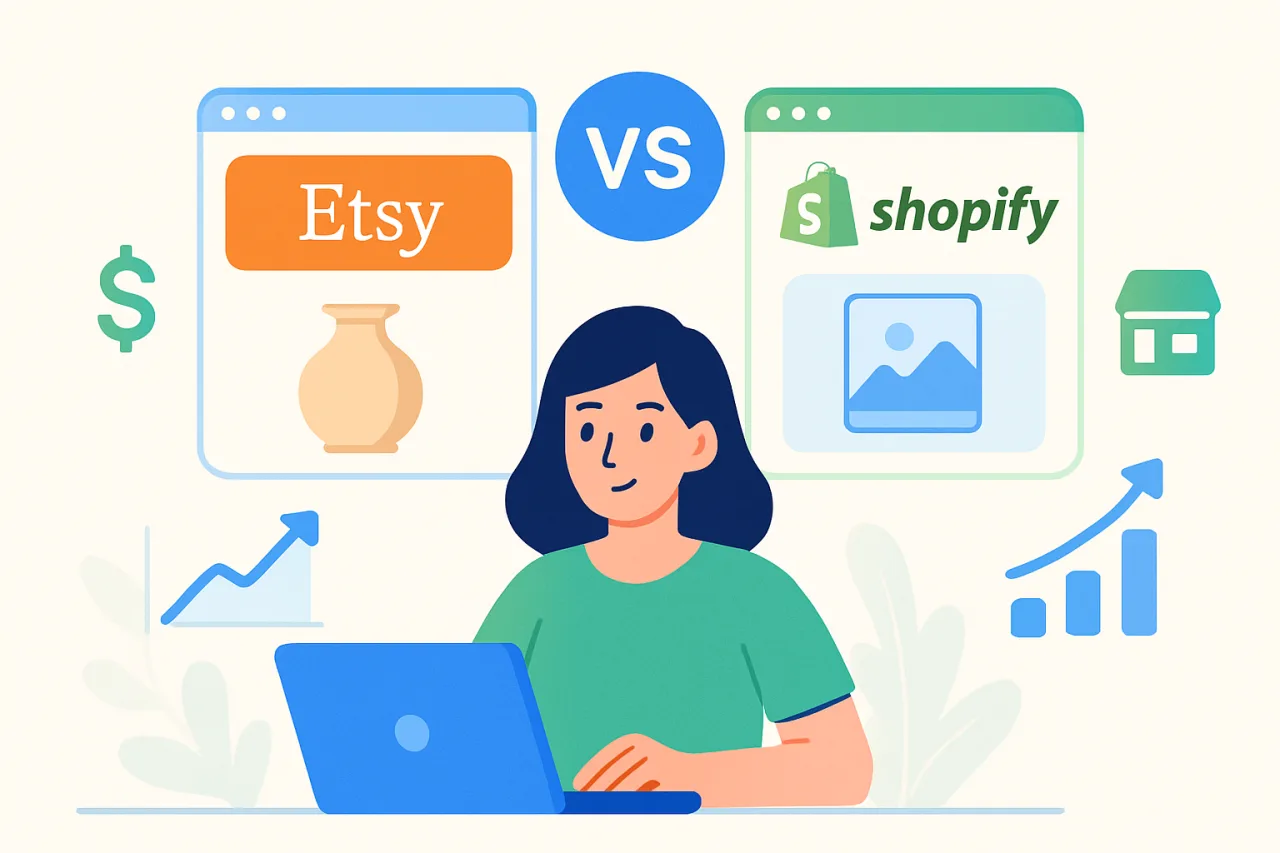
Almost every difference between Etsy and Shopify comes down to one trade-off. Etsy gives you traffic but not control — millions of buyers, but on Etsy's terms, competing beside other sellers. Shopify gives you control but not traffic — your own branded store and customer list, but an empty one you must fill with visitors yourself. Everything below flows from that. Which is right for you depends on whether your bottleneck today is getting seen (choose Etsy) or owning the relationship (choose Shopify).
Etsy's advantage: built-in buyers
Etsy's marketplace brings millions of ready-to-buy shoppers actively searching to purchase. You do not pay for that traffic — you compete for it with SEO. Setup is fast, there is no store to design or audience to build, and first sales come far sooner than on a store nobody knows exists. For most new sellers and for digital/POD products, this is decisive: you can validate what sells before investing in infrastructure.
Shopify's advantage: control
Shopify is your own store: your branding, your checkout, your customer email list, and no competitor listings on the page beside yours. You keep the customer relationship (and can remarket to them), and you are not exposed to marketplace policy changes. The price of that control is traffic — every visitor must come from your own ads, social, content or SEO. Shopify rewards sellers who can market; it punishes those who assumed "build it and they will come".
Fees compared
The fee models are structurally different. Etsy charges per-listing ($0.20) and transaction fees on each sale (see Etsy fees explained) — low fixed cost, higher per-sale cut. Shopify charges a monthly subscription plus payment processing — higher fixed cost, but no per-listing fee and a smaller per-sale cut. The rough rule: Etsy is cheaper at low volume, Shopify often wins at high volume where the subscription is spread across many sales.
Concretely, on a $25 product: Etsy takes roughly $2.63 per sale (6.5% transaction plus processing), Shopify roughly $1.03 (processing only with Shopify Payments). That $1.60 difference is what has to cover Shopify's monthly plan — which puts break-even somewhere around 20–30 sales a month at that price point. Run your actual numbers in the fee calculator, and see the full cost and shipping comparison for the worked maths.
Which is better for digital downloads?
Etsy delivers digital files natively: upload once, the buyer receives them instantly on payment, Etsy hosts and serves them, and there is no extra charge. Shopify needs a third-party app for digital delivery, which typically adds a monthly cost on top of the subscription — though those apps give you controls Etsy lacks, such as download limits, expiry windows and licence keys.
The stronger consideration is margin. With no cost of goods, Etsy's ~11–15% comes directly out of profit, so at volume the flat Shopify subscription looks increasingly attractive. The counterweight is that digital products are overwhelmingly discovery purchases — nobody sets out to buy your specific SVG pack; they search "boho printable wall art" and buy whatever ranks. That search happens on Etsy, which is why digital sellers who leave the marketplace entirely usually regret it.
What about shipping?
For physical sellers this is often the practical decider. Etsy gives you discounted labels inside the platform, shipping profiles you build once and reuse, calculated rates by address, and automatic tracking sync — plus real search pressure toward free domestic shipping, which in practice means building the cost into your price.
Shopify gives you far more granular control — custom zones, weight tiers, per-region rules, carrier-calculated rates on higher plans — and discounted labels in supported countries. The trade is consistent with everything else here: Etsy is opinionated and fast to set up, Shopify is flexible and expects you to know what you want. A misconfigured Shopify rate table quietly loses money on every order until you catch it.
The hybrid play (what top sellers do)
It is rarely either/or, and treating it as a permanent choice is the actual mistake. The common winning pattern runs in sequence: start on Etsy for discovery, use it to find what sells and build reviews, then add Shopify to own the customer relationship and capture repeat buyers at better margins — listing the same catalog on both.
The order matters. Etsy's commission is really a customer acquisition fee, and it is cheap compared to buying that traffic yourself: if replacing Etsy's organic reach costs you $8 per customer in ads, Shopify's "cheaper" $1.03 per sale is actually $9.03. Move when you have an email list, a following or brand searches — not before.
The one requirement for the hybrid to pay off is production capacity: maintaining two storefronts only works if you can create and update listings fast.
The fastest way to act on everything below: EtsyFlow turns a folder of designs into finished, SEO-optimized Etsy listings — mockups, a product video, title, description and all 13 tags — in one batch run.
Frequently asked questions
Is Etsy or Shopify better for beginners?
Etsy, usually. It brings ready-to-buy traffic and requires little setup, so first sales come faster. Shopify suits sellers who are already able to drive their own traffic and want to build a standalone brand.
Is Etsy or Shopify cheaper?
Etsy is cheaper at low volume since you pay nothing until you sell. On a $25 product Etsy costs about $2.63 per sale against Shopify's ~$1.03, so Shopify's subscription pays for itself at roughly 20–30 sales a month — but only if those sales happen without paid traffic, which Shopify does not provide.
Can I sell on both Etsy and Shopify?
Yes, and many top sellers do — Etsy for discovery of new customers, Shopify to own the list and capture repeat sales at better margins. It only scales if you can produce and maintain listings for both efficiently.
Do I get more traffic on Etsy or Shopify?
Etsy provides the traffic — millions of shoppers actively searching — though you compete with other sellers for it. Shopify provides none by default; every visitor must come from your own SEO, ads, social or email.
Is Shopify better for selling digital downloads?
Only once you have your own audience. Shopify preserves more margin and offers download limits and expiry controls, but needs a paid app for delivery. Etsy delivers files natively at no extra cost and, crucially, supplies the discovery traffic that digital products depend on.
Should I move from Etsy to Shopify?
Rarely as a replacement, and almost never before you have an audience. Add Shopify once you have an email list, social following or brand searches, then run both — Etsy for discovery, your store for repeat purchases.
Stop listing one design at a time
EtsyFlow generates mockups, a product video, an SEO title, description and all 13 tags for a whole folder of designs in one batch run.
Start free — no card required